
 EN
EN
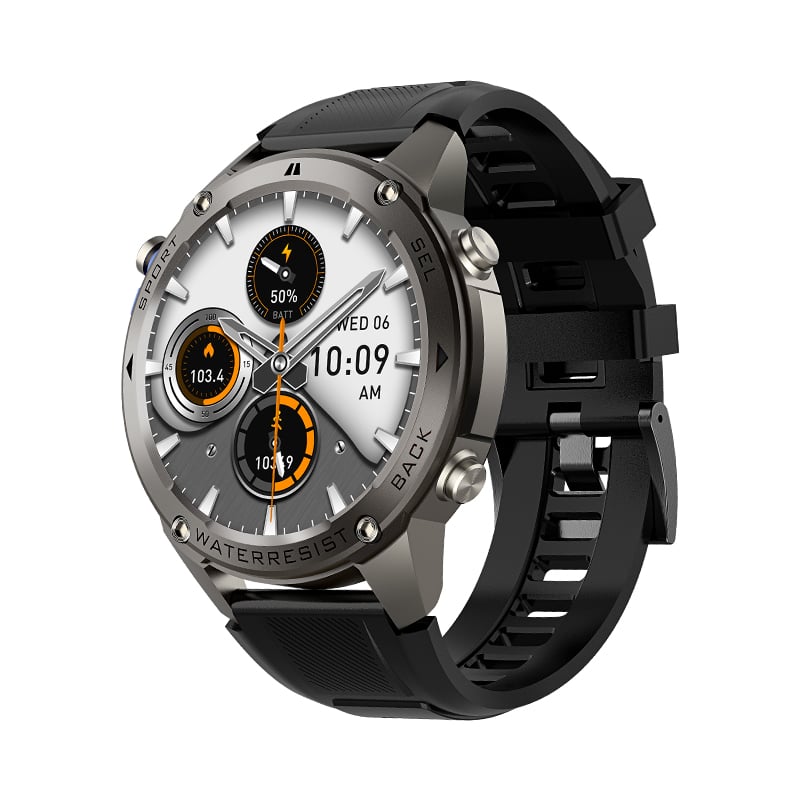
Precision Navigation: How GPS in a Smartwatch Powers Outdoor Wayfinding
Multi-band GPS and Real-Time Route Guidance
Modern smartwatches with GPS leverage multi-band Global Navigation Satellite Systems (GNSS)—including GPS, GLONASS, and Galileo—to achieve positioning accuracy within 1–3 meters, even beneath dense forest canopies or amid urban skyscrapers. Unlike smartphone GPS, which drains battery rapidly and falters under signal obstructions, dedicated watch chipsets maintain satellite locks up to 30% longer while using minimal power. Real-time route guidance overlays directional arrows and distance markers directly on your wrist, syncing with barometric altimeters to dynamically adjust elevation-aware paths. For instance, leading models use altitude data to reroute hikers around sudden terrain shifts—keeping navigation seamless without requiring phone checks. This precision is essential when trails vanish or weather changes abruptly, letting you stay present in the environment instead of distracted by screens.
Topographic Maps, Route Tracking, and Breadcrumb Trails
Offline topographic maps turn your watch into a pocket-sized wilderness guide—displaying contour lines, water sources, and trail gradients without cellular service. After plotting a course via companion apps, the watch tracks progress while overlaying key metrics like ascent rate and estimated finish time. If you stray off-route, breadcrumb trails—digital markers placed at regular intervals—form a visual backtracking path to prevent disorientation. Field testing by the Backcountry Safety Institute (2023) found this reduces wrong turns by up to 70% compared to non-GPS alternatives. For multi-day treks, solar charging support extends battery life beyond 50 hours, ensuring uninterrupted tracking from trailhead to summit.
Safety First: Emergency Features Built into a Smartwatch with GPS
SOS, Fall Detection, and Incident-Triggered Alerts
GPS-enabled smartwatches significantly elevate outdoor safety through proactive emergency systems. The SOS function lets users instantly trigger distress signals—even without cellular service—transmitting precise coordinates to rescue services, a critical advantage for solo hikers in remote areas. Fall detection algorithms analyze impact force and post-fall immobility to automatically alert emergency contacts if needed. For high-risk activities like rock climbing or backcountry skiing, customizable incident triggers monitor abnormal biometrics (e.g., sudden heart-rate spikes) or prolonged inactivity. Research published in the Wilderness Medicine Journal (2023) shows that providing exact location data shortens emergency response times by 30–50%, substantially improving outcomes in life-threatening situations.
Real-Time Location Sharing and Live Tracking for Group Expeditions
Group adventures benefit from continuous, synchronized location updates across shared digital maps. Each member’s position refreshes in real time—enabling leaders to spot deviations instantly, whether a kayaker drifts off-river or a mountaineer falls behind. Geofencing adds another layer of protection, sending alerts when participants enter predefined hazardous zones, such as avalanche-prone slopes. During emergencies, rescue teams can access live coordinates for all members simultaneously, accelerating coordinated extraction. For family hikes or educational treks, this capability ensures accountability and peace of mind—without relying on constant radio check-ins.
Built for the Wild: Durability, Battery Life, and Environmental Resilience
Rugged Design: Waterproof, Shockproof, and Extreme-Temperature Performance
A smartwatch built for serious outdoor use must endure punishing conditions. IP68-rated water resistance guarantees full submersion survival during river crossings or torrential downpours. Shockproof construction certified to MIL-STD-810G standards protects against drops onto rocks or uneven terrain. Thermal management systems ensure stable operation from -20°C alpine ascents to 50°C desert traverses. Reinforced polymer casings and sapphire crystal glass resist scratches and maintain GNSS signal integrity—so navigation remains reliable when it matters most.
Extended Battery Optimization and Solar Charging Support
Multi-day expeditions demand intelligent power management. Advanced processors reduce GPS energy consumption, enabling up to 30+ days of operation in battery-saver mode. Integrated solar charging converts ambient sunlight into supplemental power—adding up to 20% daily capacity under optimal conditions. Combined with power-efficient displays and automatic activity detection, this dual-strategy approach sustains continuous tracking across week-long wilderness trips, eliminating battery anxiety and keeping your focus where it belongs: on the journey ahead.
FAQ
What is multi-band GPS, and how does it improve navigation?
Multi-band GPS uses multiple satellite systems like GPS, GLONASS, and Galileo to enhance accuracy, typically to within 1–3 meters, offering reliable navigation even under challenging conditions like dense forest canopies or urban skyscrapers.
How does breadcrumb trail tracking work?
Breadcrumb trails place digital markers at intervals along your route, allowing users to visually retrace their paths if they stray off course, reducing disorientation during outdoor expeditions.
What safety features are available in GPS-enabled smartwatches?
These smartwatches include SOS distress signals, fall detection, and incident-triggered alerts to transmit location data and improve response times during emergencies, especially in remote areas.
Can GPS-enabled smartwatches handle extreme environmental conditions?
Yes, these devices are designed with IP68 water resistance, shockproof construction, and materials suited for operation in temperatures ranging from -20°C to 50°C.
How does solar charging benefit multi-day expeditions?
Solar charging supports extended battery life by converting sunlight into supplemental power, enabling uninterrupted tracking during long wilderness trips.


